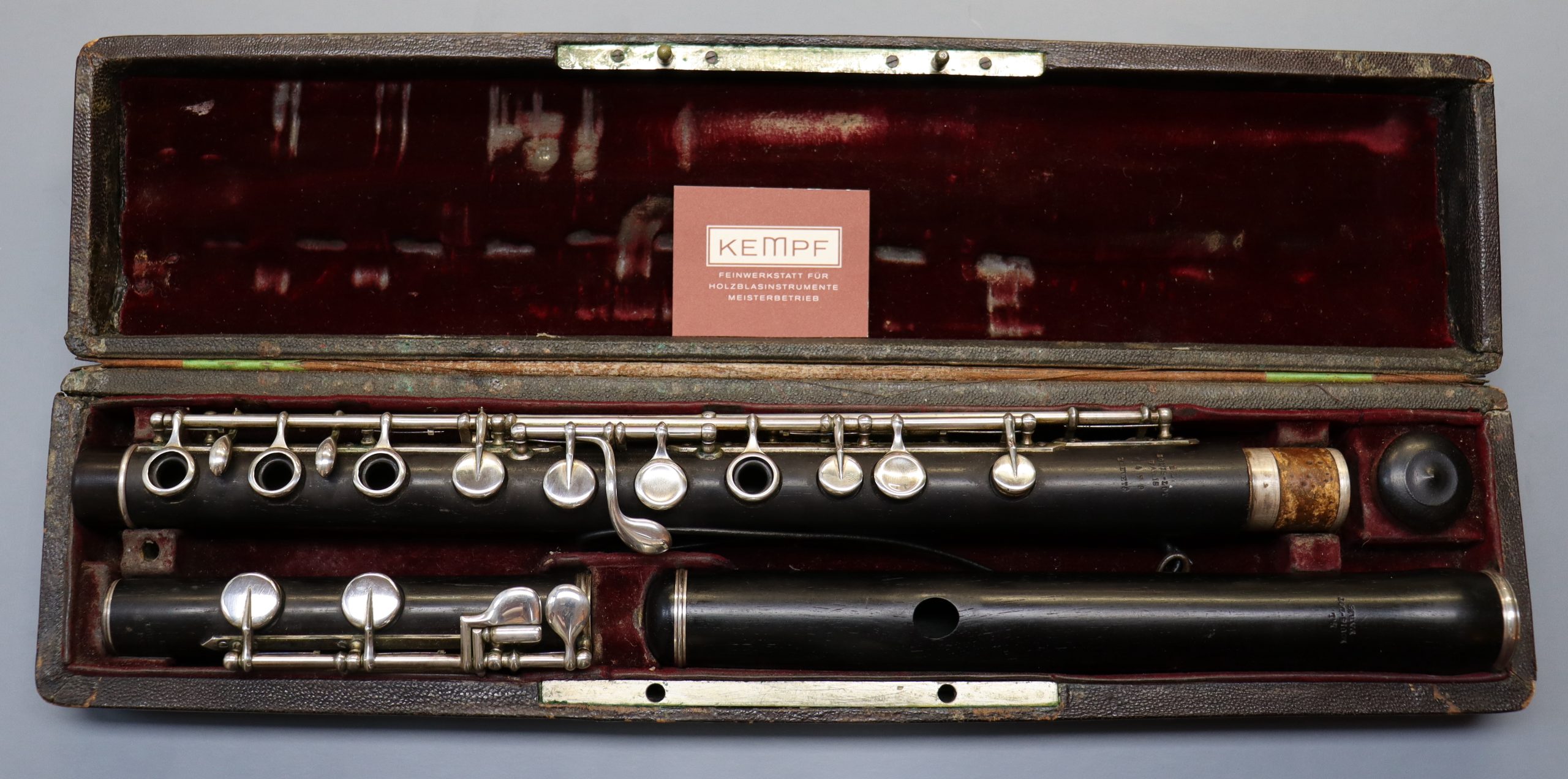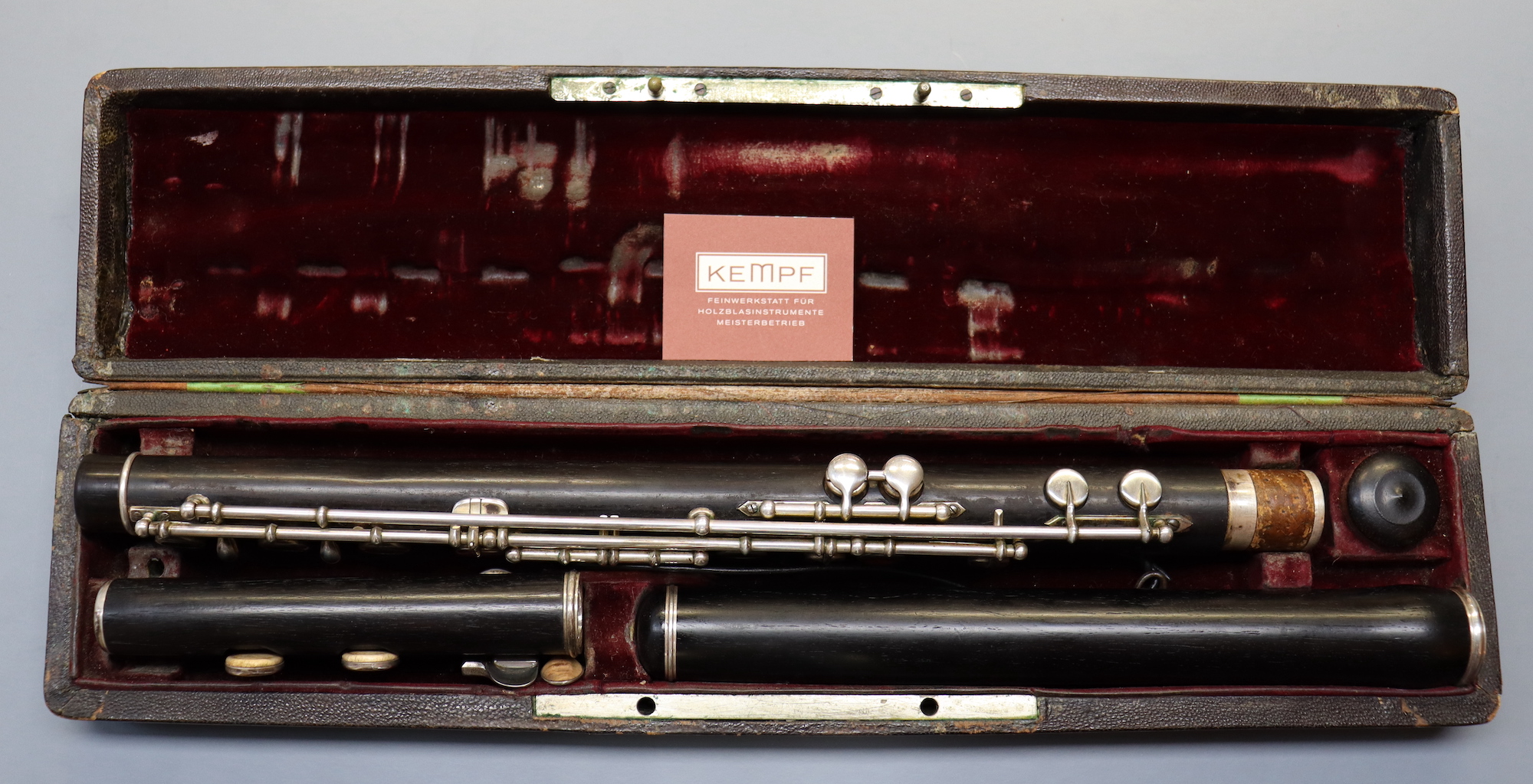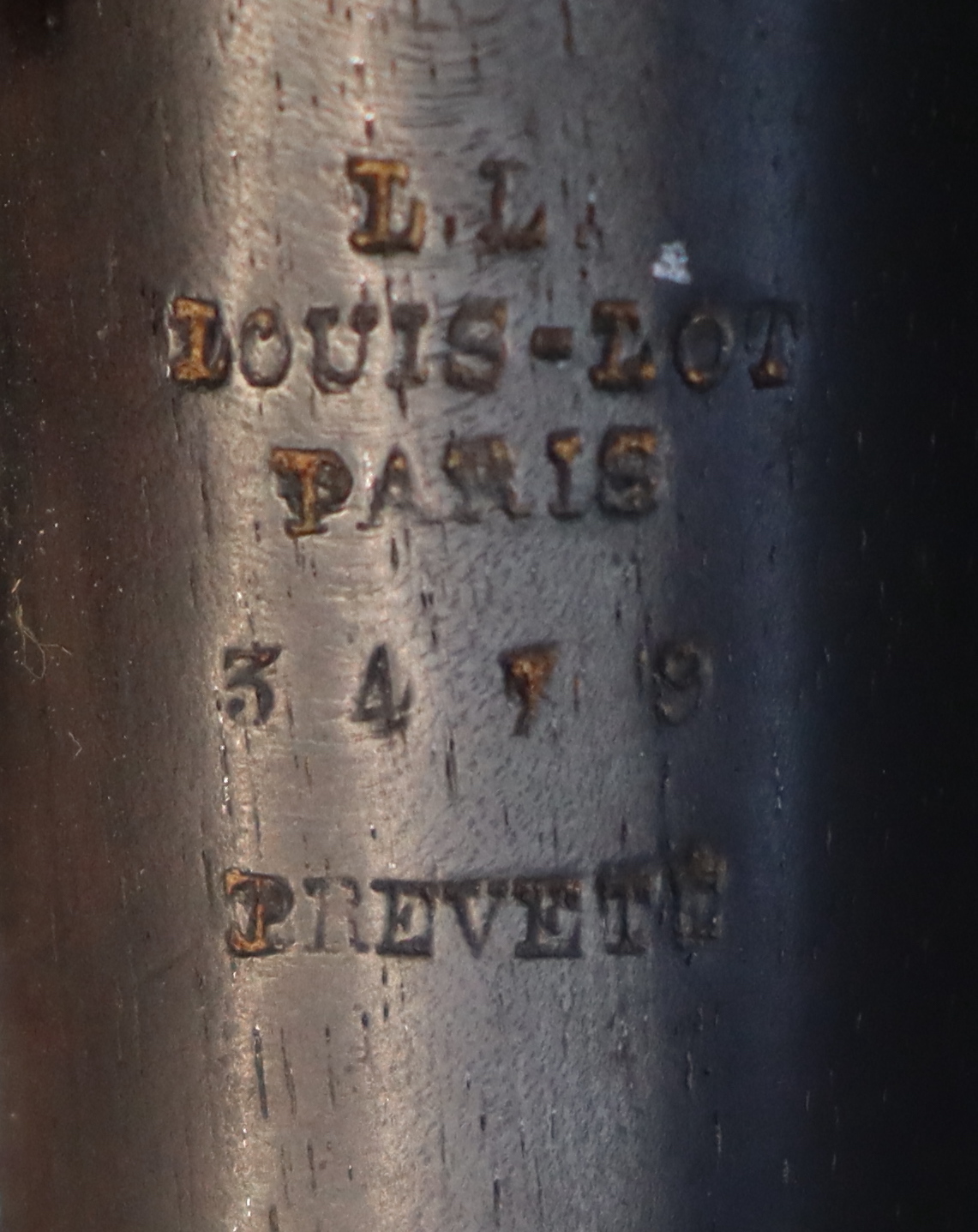
konische Ringklappenflöte Louis Lot Paris Nr 271
Preis: 7998 Euro konische Ringklappenflöte Louis Lot Paris Nr 271, Modell 1832, sehr frühes und seltenes Exemplar gebaut von Louis Lot persönlich, feinporiges Grenadillholz, Mechanik Neusilber, Dorus-Gis (spielt sich wie geschlossen Gis), D-Fuß, Mundloch Maße: 9,7×11,5mm, Schwingende Länge 520mm, spielt ganz zusammengesteckt auf a 446 Hz, ausgezogen bis 440 Hz. wunderschöner gut tragender Ton, wahrscheinlich handelt es sich um die Flöte auf Seite 80 des Geschäftsbuchs von Lot, gebaut im April 1858 für den Flötisten Nauwelaers aus Lyon. Originales Etui.
Price: €7,998
Conical Ring-Key Flute – Louis Lot Paris No. 271, Model 1832
Very early and rare example, personally built by Louis Lot himself. Made from fine-grained grenadilla wood, with nickel silver keywork.
Features Dorus G# key (plays like a closed G#), D-footjoint.
Embouchure hole dimensions: 9.7 x 11.5 mm
Acoustic length: 520 mm
Plays at A = 446 Hz when fully assembled, can be pulled out to A = 440 Hz.
Produces a beautiful, well-projecting tone.
It is very likely the flute listed on page 80 of Louis Lot’s workshop ledger, built in April 1858 for the flutist Nauwelaers from Lyon.
Includes the original case.


Louis Esprit Lot (1807–1896)
Frühe Jahre und Werdegang
Louis Esprit Lot wurde am 17. Mai 1807 in La Couture (heute La Couture-Boussey), Frankreich, geboren – einer Region, die seit dem 17. Jahrhundert für den Bau von Holzblasinstrumenten bekannt ist.
1827 zog er nach Paris und begann seine Ausbildung im Werkstattbetrieb von Clair Godfroy. 1833 heiratete er Godfroys Tochter Caroline Joséphine, und 1836 wurde er gemeinsam mit Vincent Hypolite Godfroy Teilhaber der Firma Godfroy fils et Lot.
Beiträge zur Flötenentwicklung
Ab etwa 1837 begann Lot gemeinsam mit der Familie Godfroy, das erste französische Modell der Böhm-Ringklappenflöte zu bauen, basierend auf Theobald Böhm’s 1832er Entwurf. 1847 erhielt das Unternehmen die exklusive Lizenz zur Fabrikation der Böhm-Zylinderflöte in Frankreich.
Eigene Werkstatt & Paris Conservatoire
1855 gründete Lot seine eigene Werkstatt in Paris und erlangte bald große Bedeutung – sogar Böhm selbst ließ Teile bei ihm fertigen, da er den Auftragsumfang nicht mehr bewältigen konnte. 1860 wurde er offizieller Flötenlieferant des Pariser Konservatoriums, was mit dem Amtsantritt von Louis Dorus als Professor einherging (Tulou war ein Gegner des Böhm-Systems)
Das „französische Modell“ & technische Innovationen
1867 präsentierte Lot auf der Pariser Weltausstellung seine überarbeitete Flöte: dickere Wandungen, größere Tonlöcher, ein quadratischeres Mundloch und eine stabilere Mechanik mit verbesserter G#-Klappe – dieses Design wurde zum weitverbreiteten „französischen Modell“
Goldflöte & Ruhestand
1869 fertigte er eine einzige Goldflöte für den Flötisten Jean Rémusat – dieses Instrument gelangte 1948 in den Besitz von Jean-Pierre Rampal.1875 trat Lot in den Ruhestand zurück – seine Werkstatt hatte zu diesem Zeitpunkt etwa 2.150 Flöten und Piccolos gefertigt.
Nach seinem Tod wurde seine Werkstatt fortgeführt, bis die Marke schließlich 1951 von SML Strasser-Marigaux übernommen wurde.
Vermächtnis & Einfluss
Louis Lot gilt als einer der prägendsten Flötenbauer des 19. Jahrhunderts. Das von ihm entwickelte französische Boehm-Modell beeinflusste Generationen – insbesondere durch Hersteller wie William S. Haynes und Verne Q. Powell, die seine Konstruktionen in den USA weiter adaptierten. Seine Flöten werden bis heute für ihren warmen, „singenden“ Klang geschätzt.
Louis Esprit Lot (1807–1896)
Early Years and Career
Louis Esprit Lot was born on May 17, 1807, in La Couture (now La Couture-Boussey), France — a region renowned since the 17th century for the making of woodwind instruments.
In 1827, he moved to Paris, where he began his training in the workshop of Clair Godfroy. In 1833, he married Godfroy’s daughter, Caroline Joséphine, and in 1836, he became a partner in the firm Godfroy fils et Lot, alongside Vincent Hypolite Godfroy.
Contributions to Flute Development
Around 1837, Lot and the Godfroy family began building the first French model of the Boehm ring-key flute, based on Theobald Boehm’s 1832 design. In 1847, the company was granted the exclusive license to manufacture Boehm’s cylindrical flute in France.
Own Workshop & Paris Conservatoire
In 1855, Lot established his own workshop in Paris and quickly gained prominence — even Boehm himself commissioned parts from Lot, as he could no longer keep up with demand. In 1860, Lot became the official flute supplier to the Paris Conservatoire, coinciding with Louis Dorus becoming professor there (Dorus supported the Boehm system, unlike his predecessor Tulou, who had opposed it).
The “French Model” & Technical Innovations
In 1867, at the Paris World Exposition, Lot presented his updated flute design: thicker tube walls, larger tone holes, a more squared embouchure, and a more stable mechanism with an improved G# key — this design became widely known as the “French Model”.
Gold Flute & Retirement
In 1869, Lot built a unique gold flute for flutist Jean Rémusat — an instrument that later came into the possession of Jean-Pierre Rampal in 1948.
Lot retired in 1875, by which time his workshop had produced approximately 2,150 flutes and piccolos.
After his death, the workshop continued operating until the brand was acquired by SML Strasser-Marigaux in 1951.
Legacy & Influence
Louis Lot is considered one of the most influential flute makers of the 19th century. The French Boehm model he developed shaped generations of flutists and makers — particularly inspiring American makers like William S. Haynesand Verne Q. Powell, who adapted his designs in the U.S.
To this day, Lot flutes are prized for their warm, “singing” tone and remain highly sought after by performers and collectors alike.